
PSYCHOLOGY
Why a Blank Afternoon Feels More Demanding Than a Full One
Open time looks like freedom. Your nervous system often treats it like unfinished work.
5 min read
01The Story
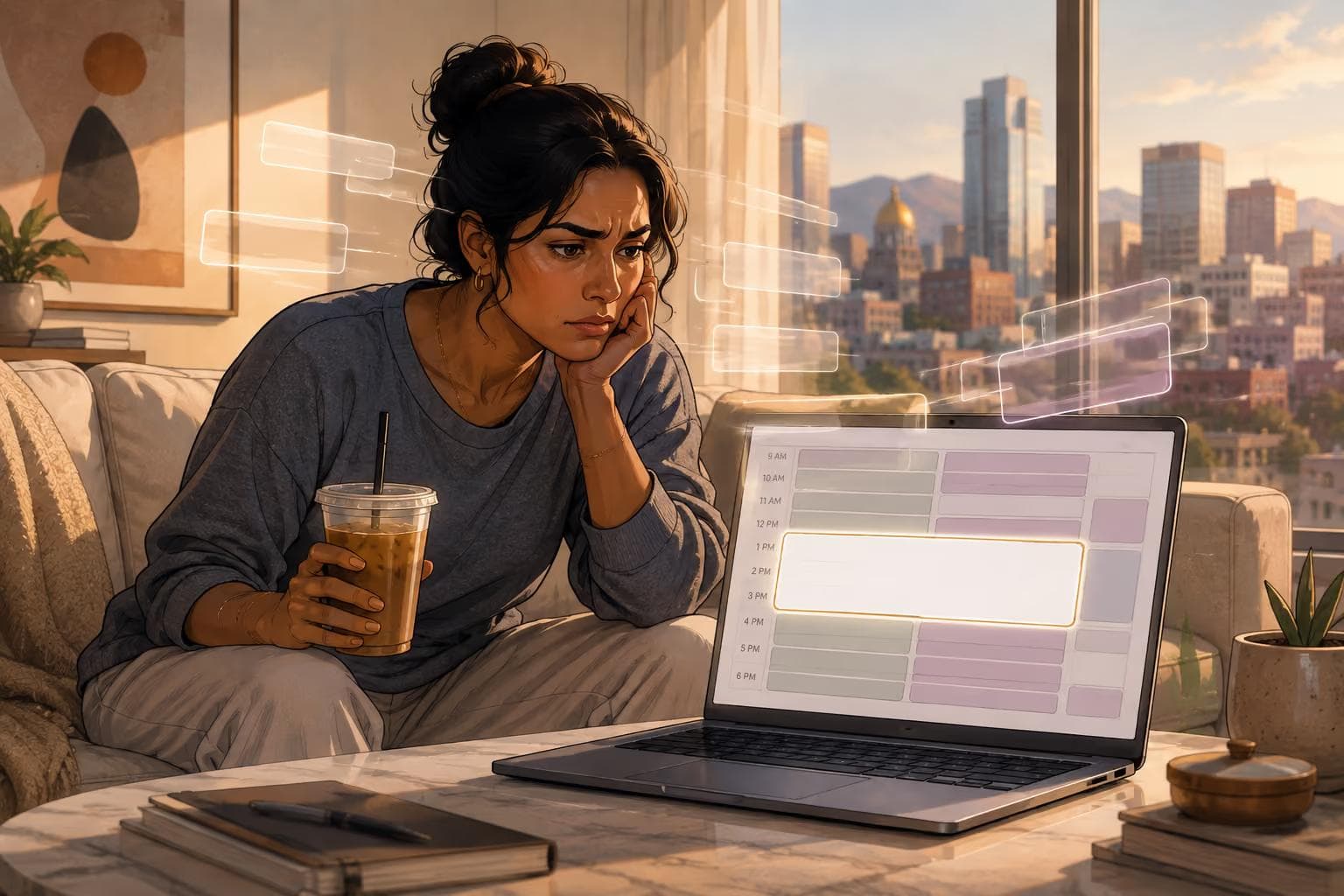
Priya, a 34-year-old operations coordinator in Denver, opens her laptop on Sunday at 1:12 p.m. The week is over. No standups. No Slack pings she has to answer. Her shared calendar shows one clean white block from noon to six: nothing. She had promised herself this exact afternoon for weeks—no errands stacked as ‘just one stop,’ no catch-up laundry dressed up as productivity. She pours iced coffee, sits on the couch, and stares at that empty rectangle like it is a meeting she forgot to prepare for.
The first twenty minutes feel almost physical. Her shoulders stay high. She refreshes the calendar once, as if an invite might appear and rescue her. She texts a friend about maybe grabbing a walk, then deletes the draft. She opens a streaming app, closes it, opens a recipe site, closes that too. The apartment is quiet in a way that should feel soft. Instead it feels unfinished, like a room with the lights on and no one assigned to turn them off.
By 2:00 she is folding a throw blanket that did not need folding. By 2:20 she is scrolling other people’s weekends—hikes, brunch tables, kids’ soccer sidelines—not because she wants those scenes, but because labeled activity looks safer than her blank slate. The afternoon she fought to protect starts to feel like a test she is failing by sitting still.
Story → Contradiction: Priya finally got the free time she wanted. The empty calendar did not relax her. It pressed on her.
02What Happened?
Priya did not suddenly become lazy, dramatic, or bad at resting. She ran into a modern-life pattern: unstructured time can feel more demanding than structured time. A full afternoon hands you a script. A blank afternoon asks you to invent one while your brain still runs on weekday urgency.
In plain English, her nervous system treated open hours like an unread task list. Without a label—workout, grocery run, call Mom—the time did not register as rest. It registered as absence. Absence feels like falling behind, even when nothing is due.
That is why a packed Saturday can feel oddly calming, and a clear Sunday can feel loud. Busyness is not always about doing more. Sometimes it is about having a story for what you are doing.
03The Hidden Logic
Modern American life trains people to live in labeled blocks. Meetings, deliveries, school pickups, gym classes, calendar holds—each one tells the brain what this hour is for. Labels reduce decision load. They also reduce ambiguity, and ambiguity is expensive. When the label disappears, the brain does not automatically switch into ease. It keeps scanning for the next assignment.
One way to understand this is through what we can call Unlabeled Hours: time with no title, no witness, and no obvious output. Unlabeled Hours do not feel neutral. They feel unfinished, because so much of daily life rewards visible completion—messages answered, boxes checked, plans confirmed. An open afternoon offers none of that proof. So the mind invents pressure to manufacture it: tidy something, plan something, compare yourself to someone who seems ‘using’ the day better.
This is not a personal failure of discipline. It resembles status-and-attention habits wearing a leisure costume. If your week teaches you that worth shows up as motion, stillness can feel like a reputation risk—even alone on a couch. Convenience makes the pattern worse. With endless small options available in a phone, a blank afternoon becomes a menu with no default. Choice without a frame feels like work.
The force repeats because it is useful in short bursts. Labeling time helps people coordinate, meet deadlines, and feel competent. The same habit over-applies on the weekend. Your brain keeps the office operating system running after the office closed. The blank afternoon is not empty. It is full of unassigned meaning, and unassigned meaning is exhausting.
04Where You See It
At work, a meeting-free afternoon can feel more stressful than back-to-back calls. People fill the gap with inbox theater—not always because the messages matter most, but because an open block looks suspicious to a mind trained on visible motion.
On phones, a quiet evening becomes a hunt for a ‘valid’ activity: a show worth finishing, a workout worth logging, a chat worth answering. The device offers infinite labels. Choosing none feels like wasting the night. Choosing too many feels like failing to rest.
With money and household life, free hours turn into chore inflation. A blank Saturday morning expands into ‘while I’m at it’ errands until leisure is postponed again. The afternoon was free. The mind treated freedom as a storage unit for unfinished life admin.
In friendships and family calendars, shared schedules make open time look rare and therefore high-stakes. If everyone else appears booked, your empty slot can feel like social proof that you are behind—even when you are simply available. Technology multiplies the effect: notification stacks and recommendation feeds keep offering titles for your hour until an untitled hour feels unnatural.
05What You Can Do
Use a mental model called Name the Hour, Not the Output. Before you fill a blank afternoon, give the block a label that protects rest without demanding achievement: ‘recovery window,’ ‘unscheduled on purpose,’ ‘low-stimulus block.’ The point is not to become more productive. The point is to stop your brain from treating emptiness as a defect.
Then add one constraint: one allowed activity family, not twelve options. Walk or stretch. Read or sit outside. Cook or do nothing with music. A small frame reduces the Blank Space Tax—the extra mental cost of open time with no story. If comparison scrolls start, treat them as a symptom of unlabeled hours, not as proof that your afternoon is failing.
The reframe is simple and reusable: busy time asks you to perform. Blank time asks you to decide. Decide less. Name the hour. Let the label do the calming work your nervous system is hunting for.
06The Takeaway
It felt like you were wasting a free afternoon—when you were really negotiating with hours that had no name.
The Takeaway
It felt like you were wasting a free afternoon—when you were really negotiating with hours that had no name.