
PSYCHOLOGY
Why Paying Later Makes Buying Feel Smaller
When the bill is far away, the purchase feels lighter — even when the dollars are the same.
5 min read
01The Story
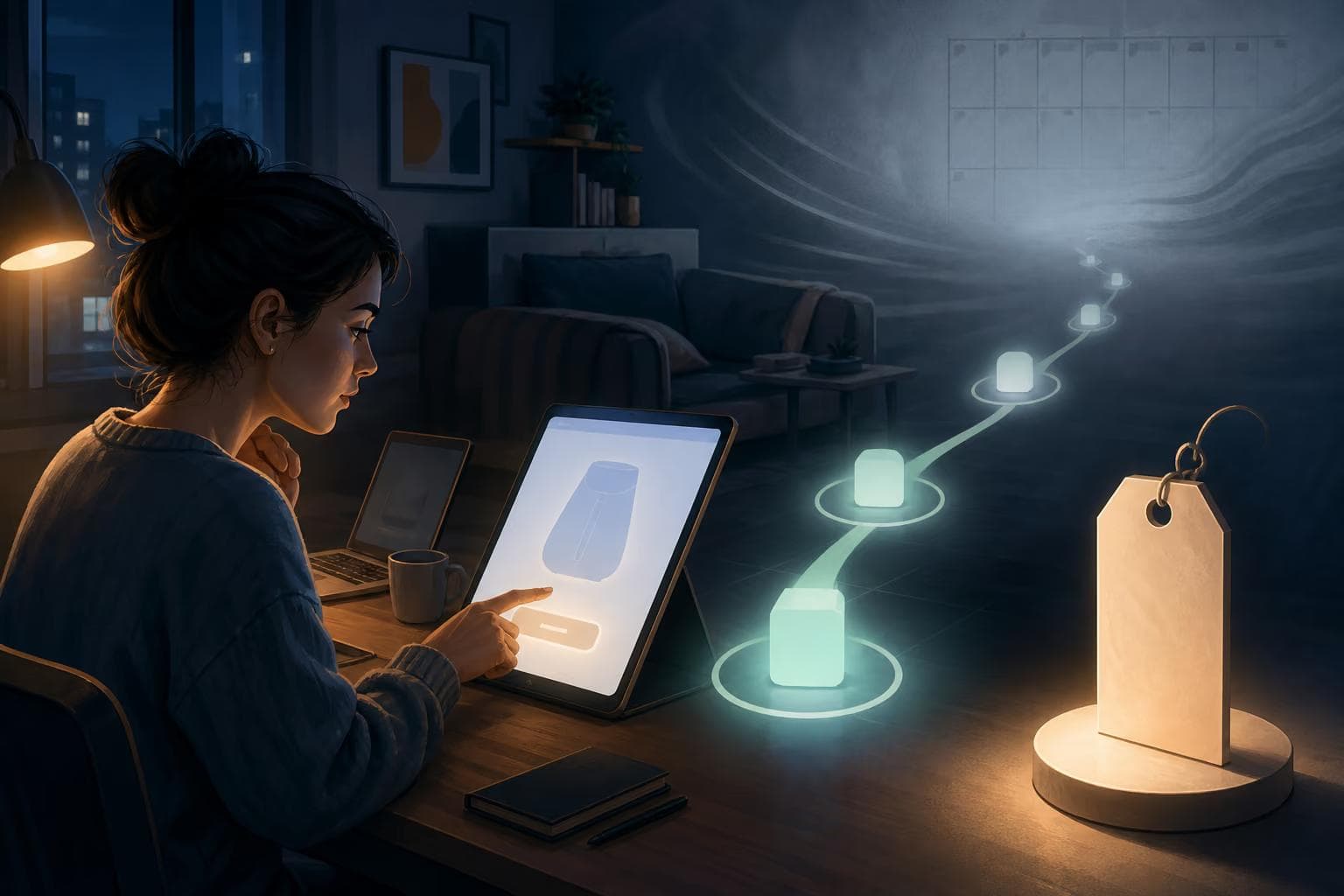
Maya is a project coordinator in Austin. On a Tuesday night, after a long sprint review, she opens her laptop and lands on a pair of noise-canceling headphones she has been “researching” for three weeks. The page is clean. The reviews are glowing. The price is $279 — not nothing, but not a crisis either. Then she sees the line under the Buy button: four payments of $69.75. No interest if she pays on time.
She does the math the way tired people do math. Sixty-nine feels like dinner and an Uber. Two hundred seventy-nine feels like a decision. She taps Pay in 4 before the kettle finishes boiling. The confirmation email arrives with a soft little calendar of future charges. Maya closes the laptop feeling oddly responsible, like she negotiated with the future and won.
Two weeks later, the second charge hits the same week her car inspection comes due. The headphones are already part of her commute. The payment feels like it belongs to a different person — the Tuesday-night version of Maya who was sure this was fine. She is not broke. She is not reckless. She is just confused by how small the purchase felt when the money was not leaving all at once.
Story → Contradiction: The headphones cost the same dollars either way. Only the distance between wanting and paying changed — and that distance made the spend feel smaller than it was.
02What Happened?
Maya ran into a simple pattern: when payment is delayed, split, or softened, the purchase shrinks in the mind even though the total does not. Cash feels sharp. A full charge feels solid. Four smaller future charges feel polite.
This is not about being bad with money. It is about how the brain prices pain. Spending is not only a transfer of dollars. It is also a moment of discomfort — the little flinch when money leaves. Move that flinch into next month, or break it into pieces, and the flinch gets quieter. Quiet flinch, easier yes.
In plain English: later payment does not just change when you pay. It changes how expensive the thing feels while you are deciding.
03The Hidden Logic
One way to understand this is through what we can call Payment Distance — the gap between the moment of desire and the moment money actually hurts. When desire and payment happen together, the cost stays vivid. When they drift apart, the cost gets foggy.
It resembles the “pain of paying” idea wearing modern checkout clothes. Tap-to-pay, saved cards, buy-now-pay-later, and “charge it to the room” all stretch Payment Distance. The product arrives in your life now. The discomfort arrives later, diluted, or dressed as a schedule. Your brain is excellent at enjoying now and underweighting later — especially when later is labeled as manageable installments.
Payment Distance also invites a quiet story: “I’m being practical.” Splitting a cost can be useful. The trap is mistaking a softer payment experience for a smaller purchase. The receipt is the same. The feeling is not. That gap is where many modern overspends hide — not in wild impulses, but in calm checkouts that never fully wake the cost.
04Where You See It
You see Payment Distance at the airport when a seat upgrade is “only” $49 on the app, charged to a card you will not open until Sunday. You see it at Amazon when one-click buys skip the pause that used to come with typing a number. You see it in furniture stores and mattress showrooms where financing turns a living-room decision into a monthly habit.
Credit cards do a gentler version of the same trick. Dinner feels like a signature, not a withdrawal. Streaming and software renewals go further: the spend becomes weather — always in the background, rarely examined. Buy-now-pay-later makes the pattern explicit. It does not invent the psychology. It packages it.
Workplaces have their own version. Expense accounts and corporate cards can make a $42 client lunch feel like theater money. Hotels train the same muscle with the mini-bar and late checkout: enjoy first, settle at the desk. Different settings, same distance between pleasure and payment.
05What You Can Do
Try a mental tool we can call the Same-Day Price Test. Before you approve a delayed or split payment, ask one question out loud: “Would I still buy this if the full amount left my account today?”
Not “Can I afford the installment?” Not “Is the APR zero?” Those questions are useful later. The Same-Day Price Test restores Payment Distance to zero for one second — long enough for the real size of the purchase to show up. If the answer is an easy yes, proceed. If the answer gets slippery — “well, not today, but…” — you just found the fog.
You do not need a new budget app for this. You need a temporary reunion between wanting and paying. Collapse the distance on purpose. Let the full price sit in the room with you. Then decide.
06The Takeaway
A purchase feels smallest when the money is farthest away — and that feeling is not the price.
The Takeaway
A purchase feels smallest when the money is farthest away — and that feeling is not the price.