
WORK
Why Staying Late Feels Like Getting Ahead
The empty office feels like progress — even when the work could have waited until morning.
5 min read
01The Story
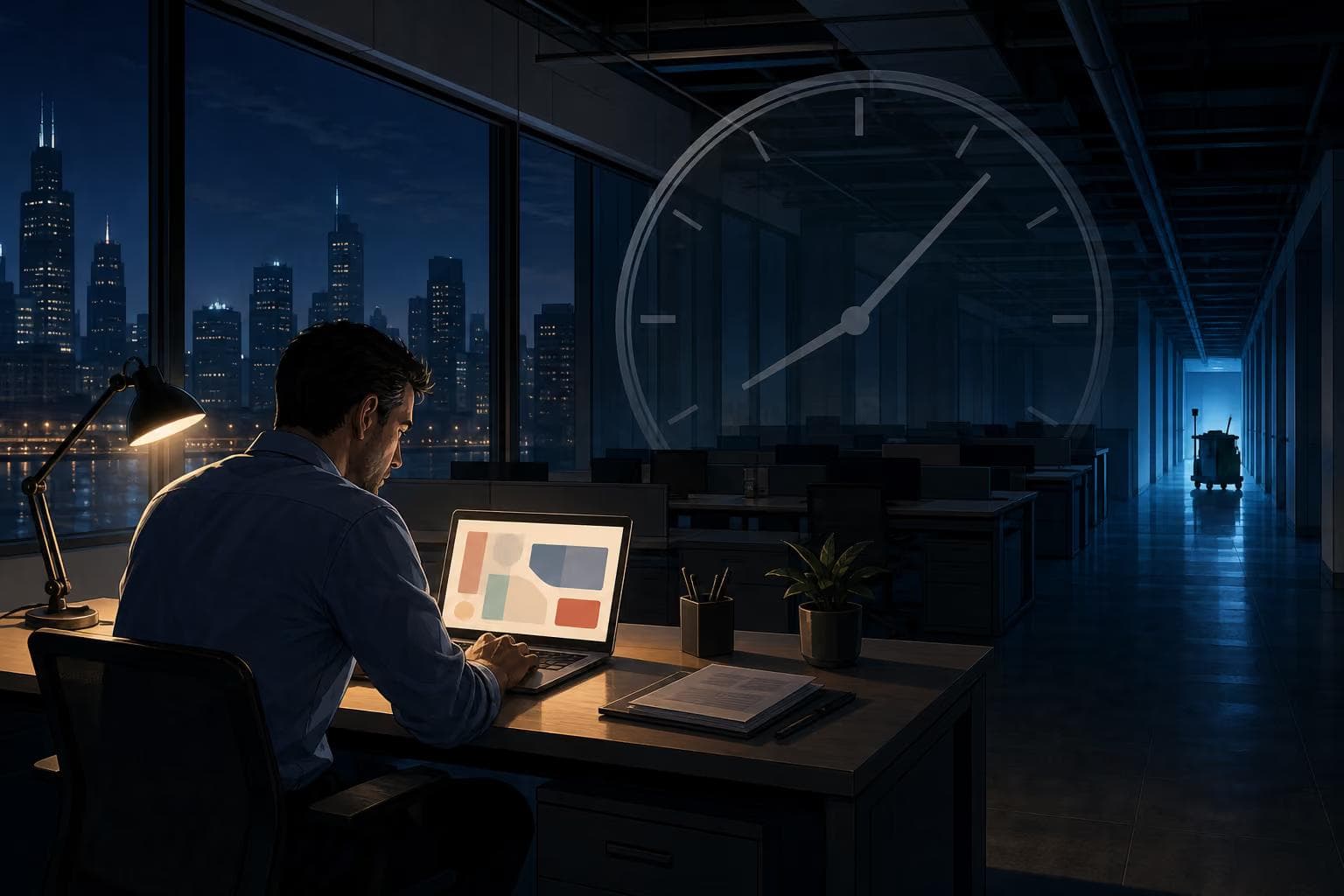
Alex is a product manager in Chicago. At 6:12 p.m., the open floor has thinned to carpet hum and the glow of a few monitors. His laptop still shows the same slide deck he has been polishing since lunch — status updates, risk callouts, a timeline nobody asked him to rebuild. He could send it tomorrow. He stays.
The building gets quieter. Security doors click. A cleaner rolls a cart past his desk. Alex tells himself this is the serious hour: fewer chats, sharper focus, the version of him that gets promoted. He adjusts fonts. He renames a column. He adds a backup slide "just in case." The work is real enough to feel productive. The urgency is mostly atmospheric.
By 8:40, his phone buzzes with a message from home about dinner gone cold. He types a quick apology, then opens the deck again. Leaving now would feel like quitting mid-rep. Staying feels like loyalty he can point to later — if anyone notices the timestamp.
He finally closes the laptop. The hallway lights are half-dim. On the train, a small contradiction settles in: he did not finish something that could not wait. He finished something that made him feel like the kind of person who finishes things after dark. The Story → Contradiction: the late night felt like advancement. The slides did not get better because the clock got later.
02What Happened?
Alex ran into a quiet workplace pattern: hours as proof. When the office empties, time itself starts to look like evidence. Extra minutes feel like extra commitment. The calendar becomes a scoreboard, even when the output barely changed.
Nothing mystical happened. The late desk offered a clean signal — I am still here — that is easier to feel than the messier question: Did this hour move the work, or only reassure me?
That is why leaving can feel like risk and staying can feel like insurance. The body reads emptiness as seriousness. The mind converts overtime into a story about who is "really" trying.
03The Hidden Logic
Careers are hard to measure in the moment. Impact shows up late, sideways, or in other people's quiet decisions. Hours are easy. You can count them. You can feel them in your eyes. So the brain reaches for a stand-in: if I cannot prove progress cleanly, I can prove presence.
Call it hours as proof. The late light becomes a costume for ambition. It does not mean every long night is wasted — some deadlines are real, some launches need the stretch. It means the feeling of getting ahead and the fact of getting ahead can drift apart. Presence is vivid. Value is often quiet.
This pattern repeats because workplaces reward what is easy to notice. A reply at 9 p.m. is visible. A sharper decision at 11 a.m. is not always. Marketers, designers, and businesses understand this pattern in their own domains — lead with the number people can see. At work, the "number" is often the clock.
So Alex is not weak for staying. He is using a familiar human shortcut: when the score is fuzzy, length looks like loyalty. The cost is subtle. Energy spent proving you care can crowd out the work that would have made care unnecessary to prove.
04Where You See It
At work, you see it in status meetings that run long because ending early feels like underperforming, and in chat threads that stay "green" after hours as a soft form of career insurance. The reply is not always about the question. Sometimes it is about being seen as reachable.
In money and household decisions, a cousin shows up when people equate longer hours with "deserving" a treat — as if time spent is a receipt that unlocks spending. The cash leaving the account is real. The moral permission is mostly framing.
In technology and daily tools, it appears whenever dashboards celebrate activity counts — messages sent, tickets touched, hours logged — while the harder metrics sit one click deeper. The busy screen feels complete. The important screen feels unfinished.
In ordinary life, it is the open laptop on the couch that signals "I am still working" to the room, including to yourself. The object stays the same. The story attached to it grows.
05What You Can Do
Use a simple reframe before you extend the day: Is this hour buying progress, or buying proof? Progress changes the work — a decision made, a risk removed, a deliverable that someone else can use tomorrow. Proof changes the story you tell about yourself — I stayed, I answered, I looked serious.
If the honest answer is proof, treat the late light as optional theater, not obligation. Move the task to the morning and name what you are protecting: sleep, judgment, the version of you that makes cleaner calls. If the answer is progress, stay with a clear finish line — one outcome, then leave.
The mental model is not "never work late." It is "do not confuse the costume with the career." Hours can support the work. They should not become the work's substitute identity.
06The Takeaway
Staying late feels like a raise you prepaid. The hours are mostly framing.
The Takeaway
Staying late feels like a raise you prepaid. The hours are mostly framing.