
PSYCHOLOGY
Why Maya's Bakery Line Became the Reason Everyone Wanted a Cupcake
A crowded room can quietly turn other people's choices into the evidence we use to make our own.
6 min read
01The Story
Maya opened a small neighborhood bakery in a busy part of Austin, Texas. Her cinnamon rolls were handmade every morning, her coffee came from a local roaster, and she spent months testing recipes before opening the doors. She believed the quality of the food would be what brought people back.
For the first few weeks, business was unpredictable. Some mornings she sold out before noon. Other days, she watched people walk by, glance through the window, and keep moving. The strange part was that the recipe had not changed. The ingredients had not changed. The experience inside the bakery had not changed.
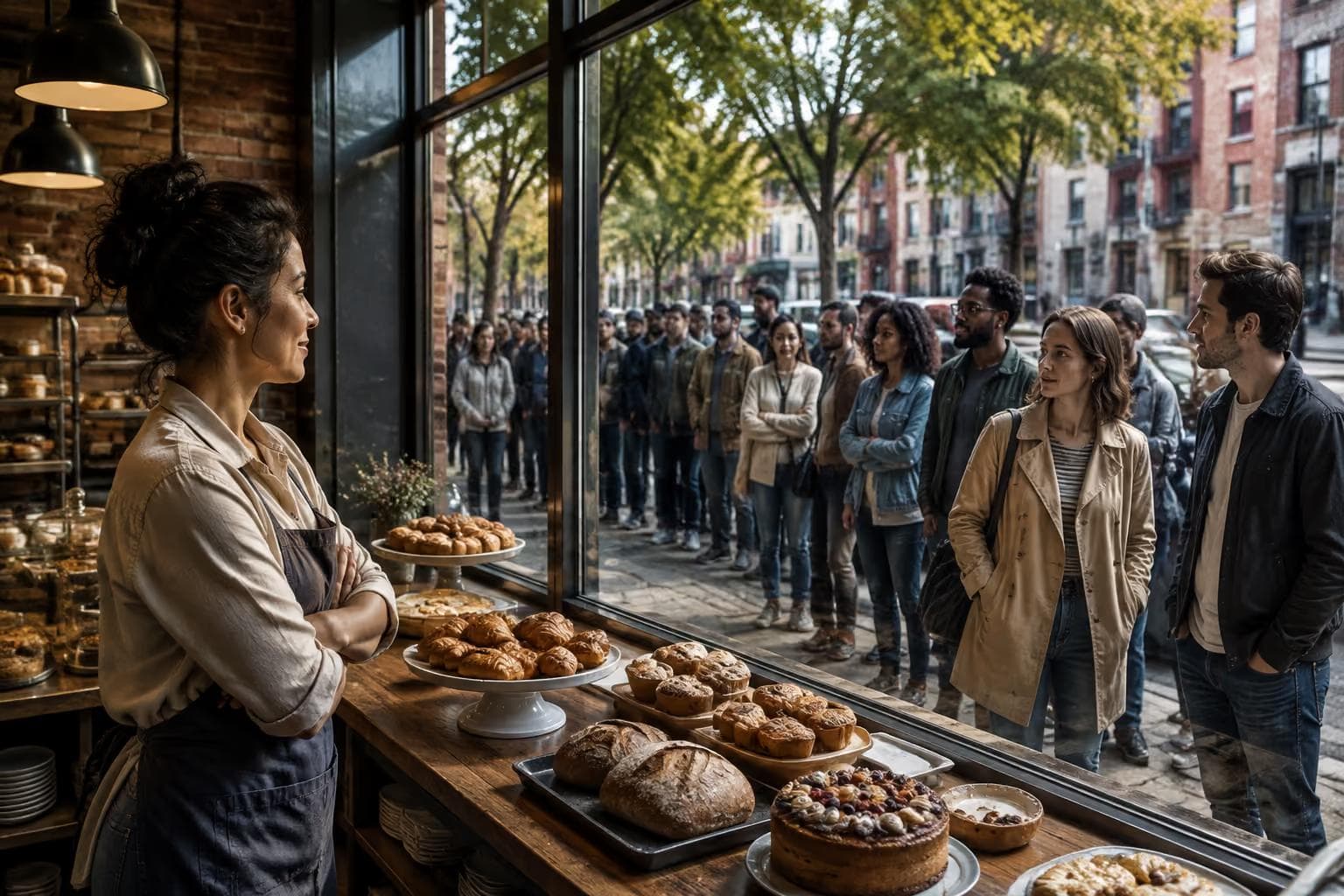
Then something unexpected happened. A popular local food blogger posted a photo of Maya's bakery during a Saturday rush. The picture showed a long line stretching down the sidewalk. By the next weekend, more people arrived, and many of them looked at the crowd before deciding to enter.
Maya noticed a pattern. People who had never heard of her bakery would slow down, count the people waiting, and say things like, "It must be good if everyone is here." The line itself had become part of the product.
The surprising part was that the crowd was not just a result of demand. It was also creating more demand. People were using other people's choices as a shortcut for their own decisions.
02What Happened?
Maya's bakery became a small example of a powerful social behavior: Social Proof. When people are uncertain, they often look at what others are doing and treat those actions as useful information.
A customer standing outside a bakery does not know everything about the food, the ingredients, or the owner's years of preparation. They cannot instantly measure quality. But they can see a line. They can see other customers buying. They can see signs that other people have already made a decision.
That visible evidence reduces uncertainty. The brain often asks a simple question: If many people are choosing this, what do they know that I do not?
This does not mean people are simply copying others without thought. Other people's behavior can genuinely provide information. If a restaurant is full every night, it might be because the food is excellent. If a product has thousands of positive reviews, those reviews might reveal something useful.
The hidden shift happens when the signal becomes more powerful than the original reason. Maya's bakery was no longer judged only by the taste of a cinnamon roll. It was also judged by the fact that other people were willing to wait for one.
03The Hidden Logic
Humans make decisions with limited time and limited information. Every day, people choose restaurants, products, jobs, investments, and even opinions without having enough time to investigate every detail.
Social Proof works because it acts like a mental shortcut. Instead of asking, "Have I personally verified this choice?" people often ask, "Are other people like me choosing this?"
This shortcut developed because groups often contain useful knowledge. For thousands of years, noticing what others avoided or followed could help people survive. If everyone moved away from a certain area, there was probably a reason. If a group gathered around a resource, it was worth investigating.
The modern world uses the same instinct in different ways. A packed coffee shop, a product with thousands of reviews, a restaurant with a waitlist, or a job candidate with many supporters can all send the message that something has value.
The challenge is that popularity and quality are not always the same thing. A crowd can reveal genuine value, but it can also create the appearance of value. A trend can grow because people see others joining, not because they independently reached the same conclusion.
This is why social proof is so powerful in marketing, communities, and everyday decisions. It does not force people to choose something. It changes what feels safe enough to choose.
04Where You See It
Online shopping is one of the clearest examples. A product with thousands of reviews often feels safer than a product with only a few reviews, even when the newer product might actually be better. The number of people who chose before us becomes part of the decision.
Social media platforms are built around similar signals. Posts with more likes, shares, and comments often attract more attention because engagement itself becomes evidence that something deserves attention.
Businesses use this idea everywhere. Restaurants display busy dining rooms. Companies highlight customer numbers. Brands show testimonials. Apps show how many people are using a service. These signals answer a question customers often have: Is this worth my time?
The workplace has social proof too. Employees may assume a project matters because many executives discuss it. Teams may trust a popular idea because many people support it. Sometimes reputation grows because people see others respecting something first.
Even personal decisions can follow the same pattern. People may choose a neighborhood, career path, or lifestyle because many others appear to be choosing it. A common path can feel safer simply because it is familiar.
05What You Can Do
The goal is not to ignore other people's choices. Social information can be valuable. The goal is to understand when it is helping you and when it is replacing your own judgment.
Before following a crowd, ask what the crowd is actually proving. A long line proves that many people are waiting. It does not automatically prove the experience is worth the wait.
Look for the original evidence behind the signal. Reviews can be useful, but read the details. A popular product can still be wrong for your needs. A common career choice can still be a poor personal fit.
Notice when popularity is being used as the main argument. Phrases like "everyone is buying it," "everyone is doing it," or "everyone wants this" can be helpful clues that social proof is influencing your thinking.
For businesses, social proof can build trust when it reflects real customer value. But the strongest brands do not only create crowds. They create experiences that give people a real reason to stay.
06The Takeaway
A crowd can be evidence, but it is not always proof. The smartest decisions come from knowing when other people's choices reveal information and when they simply create momentum.
The Takeaway
The crowd can point you toward value, but it can also make you forget to look for the reason behind it.